Strategy · Wardley
Know where to build, buy or wait
We map your AI value chain, show which parts are already commodity, and set a roadmap your board can fund.
You keepWardley maps, build-or-buy research, roadmap
Counsel for AI in regulated institutions
The Majlis of AI helps banks, telcos and governments in the GCC make AI decisions they can defend: to the board, to the regulator and to their customers. It is an advisory practice, an academy, a set of books and an open conversation.
We help you make the AI decision. Then your teams own it.
Architecture and operating-model advice for banks, telcos and governments. We work beside your architects and your risk teams, and we leave the method with them.
Strategy · Wardley
We map your AI value chain, show which parts are already commodity, and set a roadmap your board can fund.
You keepWardley maps, build-or-buy research, roadmap
Operating model
Workflow-first design from your own SOPs, with Team Topologies, decision rights and human-in-the-loop rules in DMN.
You keepTeam design, decision register, activation roadmap
Architecture
Target architecture on BIAN, TM Forum ODA or TOGAF, modelled in ArchiMate, with each decision recorded.
You keepArchiMate views, ADRs, reference-model maps
Governance-as-code
We turn CBUAE, TDRA, PDPL or EU AI Act obligations into owned, testable rules in Git, with a release gate for every model and agent.
You keepGovernance pack, traceability matrix, autonomy tiers
How we work
Ways to engage
| Shape | Use it when | You get |
|---|---|---|
| Decision sprint | One decision blocks a programme | A recommendation and a decision record, defended to your board |
| Programme design | You start or reset an AI programme | Operating model, target architecture and roadmap |
| Design authority | You run AI in production | A seat on your architecture board and a review of each release |
Sectors and frameworks
AI transformation · Open Agile Architecture™
Most AI work stops at the proof of concept. We use Open Agile Architecture, a standard of The Open Group, to shape the operating model, data platform and governance that take AI to production across the enterprise.
Intentional architecture sets the guardrails. Emergent design keeps the teams fast.
A · Strategy and operating model
Map AI use cases to value streams and customer journeys. Shape cross-functional AI product teams with the Inverse Conway Maneuver.
You keepValue-stream map, team design, product operating model
B · AI architectural runway
A central AI platform: vector stores, model registries, CI/CD for ML and observability. ADRs set the line between central standards and squad freedom.
You keepRunway blueprint, ADRs, team API contracts
C · Pace-layered governance
You keepPace-layer risk matrix
D · Continuous refactoring
Feed production telemetry back into the architecture backlog. Make red-teaming, toxicity filters and hallucination benchmarks sprint-level quality criteria.
You keepFeedback loops, automated guardrails
Packaged engagements
What each leader gets
| Leader | Problem | What changes |
|---|---|---|
| CIO · CTO | AI work splits into silos or stalls at a rigid architecture board | A federated architecture practice: central platforms let squads build compliant AI without waiting |
| CAIO · CDO | Proofs of concept fail on the way to production | Data and MLOps sit inside the value streams, on a reusable runway |
| Product and business | AI takes months and misses the business metric | Journey mapping, jobs to be done and outcome-driven design |
| CISO | Shadow AI and unvetted APIs leak IP and data | Security and compliance from the start, through automated guardrails |
Works with your frameworks
We build AI capability inside your institution.
Start with the flagship course, or bring one of our formats to your teams. Everything we teach uses your platforms, your controls and your regulator's expectations.
Flagship course · Edition 1 · Core
Mastering governance-as-code. Build one traceable governance pack for an AI solution. Keep it in Git. Defend it to a review board.
Coming soonInstructor-led
| Wk | Stage | Module | What you produce |
|---|---|---|---|
| W1 | Set up | M0Harness anatomy | Pinned repository, project plan |
| W2 | Govern | M1Govern the intent | Principles, stakeholders, risk, business case |
| W3 | Understand | M2Needs and data | Requirements with IDs, data model, DPIA draft |
| W4 | Decide | M3Research and strategy | Build-or-buy research, Wardley map, roadmap |
| W5 | Design | M4Design and decide | ADRs, diagrams as code, design review |
| W6 | Design · AI | M5Govern AI and agents | AI assessment, agent pack, autonomy tiers |
| W7 | Assure | M6Assure and extend | Traceability matrix, own recipe, docs site |
| W8 | All stages | CPCapstone | Complete pack, defended to a review board |
Set the rules, understand the need, decide, design, assure. Gaps and drift feed the next cycle. Traceability IDs link every stage.
Lab case
A synthetic agentic service assistant for a fictional regulated organisation. It answers with retrieval and does one customer action.
Synthetic data only. Never client data.
Capstone · Week 8
Govern your own AI solution from an empty repository, with your own recipe. Then face a 20-minute board: CISO, DPO and board chair.
Full spine, a recipe and two templates, a review log, ten checked citations, a docs site and a ten-slide deck.
Who it is for
The toolkit
The same harness runs in Claude Code, Codex, Gemini, OpenCode, Copilot or a CLI. Nine overlays add sector and jurisdiction rules, from the UAE and the EU to UK Finance.
How to join
| Instructor-ledComing soon | Self-pacedComing soon | |
|---|---|---|
| Format | On-site or live online | Online, on demand |
| Time | 8 weeks, about 7 h a week | About 40 h, own pace |
| Support | Instructor and peers | CI checks, forum |
| Certificate | Of achievement | Of completion |
How we assess
Pass mark for the live course: 60% overall, and at least 2 of 4 in each of the six rubric dimensions.
Planned editions
The core course comes first. Industry editions build on it, so what you learn in the core carries over.
Each industry edition adds
Formats for your institution
Bring the method in-house, from a board briefing to an accelerator track.
| Ref | Format | For | You leave with |
|---|---|---|---|
| AC-01 | Executive briefing | Board, ExCo, CTO and CIO | A shared view of AI value and risk, and a list of the decisions only you can make. |
| AC-02 | Technical bootcamp | Engineers and architects | Hands-on practice with DevOps, MLOps and LLMOps standards on a regulated platform. |
| AC-03 | Capstone programme | Cross-functional teams | One real use case, from problem statement to a reviewed ArchiMate architecture. |
| AC-04 | Hackathon | Delivery teams | Working prototypes, judged against your own controls. |
| AC-05 | Accelerator track | Platform and product teams | A capability your team runs without us after the track ends. |
capability stays when we leave
It started as a novel about the room where AI is decided.
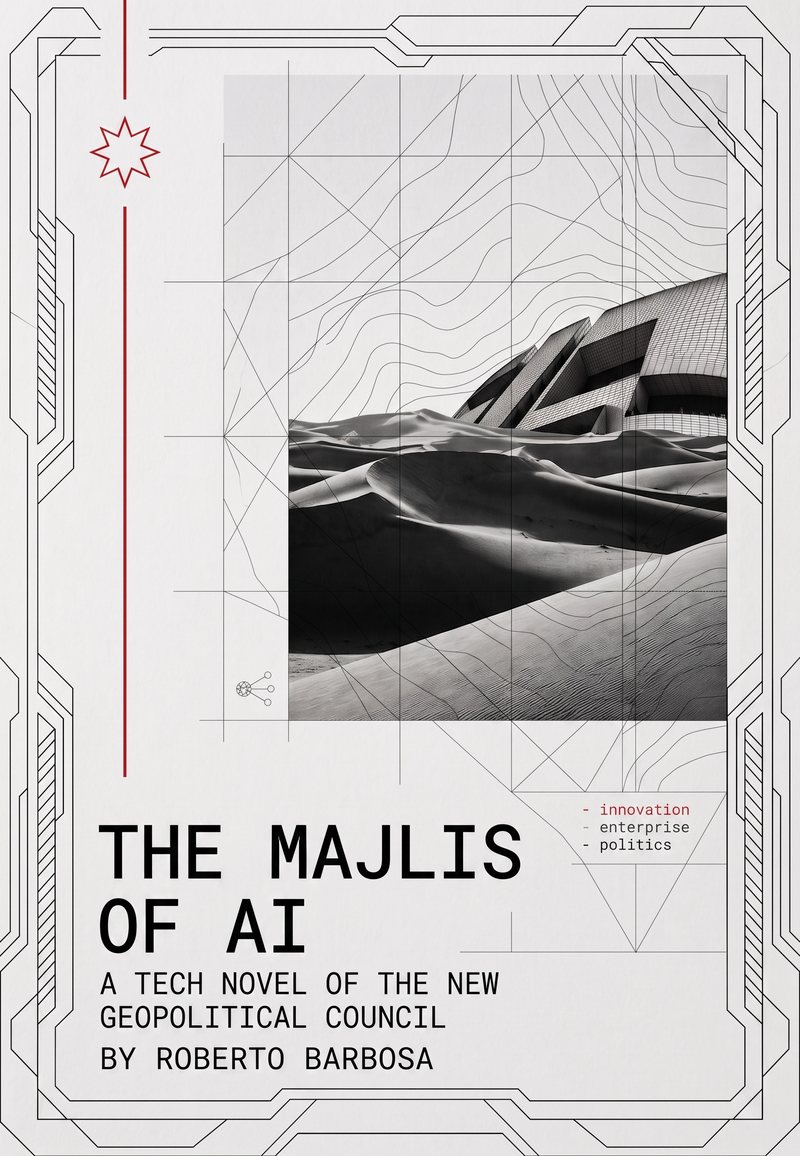
Published on Amazon
The Majlis of AI is a tech novel of the new geopolitical council, where innovation, enterprise and politics meet in the room where AI is decided.
The story gave the practice its name and its method. Everyone sits as equals, everyone listens first, and the decision is written down.
From one book to a practice
Collaborations · with Márcio Parente
A series of five books, co-written with Márcio Parente, for the people who must run AI inside a regulated institution.
Name the framework, draw its real shape.
Short pieces for architects and executives in banking, telco and government. Each one starts from a framework you already know.
One issue a month. One decision in each.
Majlis Dialogues is a short letter for people who must sign off on AI in a regulated institution. Read it in ten minutes. Bring it to your next steering committee.
In each issue
Bring us the question your institution must decide.
Write to us about advisory work, the Academy, or a briefing for your board.